A hurricane is bearing down on the Florida coast. Plywood is on the windows. Bottled water is stacked by the door. The generator has been tested. You think you’re ready.
But in the rush to secure your family and protect your belongings, there’s one vital, expensive, and deceptively fragile system that is often completely overlooked:
Your home’s central air conditioning unit.
A hurricane’s destruction isn’t just about floodwaters. For your outdoor AC condenser unit, the real danger is a triple threat of electrical surges, high-speed projectile damage, and water intrusion from massive rainfall and wind-driven rain. Leaving your AC running or unsecure during a hurricane isn't just a risk; it's practically an invitation for a total system failure—a mistake that could cost you $5,000 to $10,000 or more in the storm's aftermath.
Here is the good news: Protecting your HVAC system requires absolutely zero specialized technical skills and takes all of two minutes. It is, hands down, the single highest-return "hack" on your entire storm preparation list. Do not skip this.
Why Is Your AC So Vulnerable to Hurricanes?
Before we dive into the two-minute drill, it’s critical to understand the why. A massive metal box looks tough, but it's deceptively delicate inside.
1. The Invisible Killer: Electrical Surges
This is the number one cause of post-hurricane AC failures. When the power grid fluctuates and fails during a storm, the result is often a massive, instantaneous surge of electricity—a "spike"—that rushes down the line. If your AC is "on" and connected, this surge hits the sensitive control boards, capacitors, and the compressor motor like a lightning bolt. It can instantly fry all the computerized components. Your system is "bricked" before the power even fully cuts out.
2. Weaponized Landscape: Flying Debris
Imagine your neighborhood, but everything—shingles, lawn furniture, tree limbs, garbage cans—is being thrown through the air at 110 mph. That outdoor condenser unit is a sitting duck. A single heavy tree limb or a piece of neighbor’s fence can crumple the thin metal coil and aluminum fins of the condenser, which are crucial for heat transfer. If those fins are crushed, your AC can't breathe, and it will overheat, potentially destroying the compressor.
3. The Deluge: Water and Flooding
While the outdoor unit is built to be water-resistant, it is not built to be submerged. If massive amounts of rain (10–15 inches) flood your property, water can rise into the bottom of the unit, potentially flooding the complex electrical compartment. Furthermore, wind-driven rain can be forced into seals and areas that are normally protected, leading to corrosion and component failure weeks or months later.
The 2-Minute HVAC Hurricane Prep (Do Not Wait for a Watch)
Perform these steps as soon as a
Hurricane Warning is issued for your area. Do not wait for the storm to get close, as you'll be too busy and the weather will already be dangerous.
Phase 1: Shut It Down (Time: 30 Seconds)
1. Lower the Temperature (Pre-Cooling): In the 12 hours before the hurricane is scheduled to arrive, turn your AC thermostat down to its absolute lowest comfortable setting, like 68°F. You are effectively using your home's insulation and building mass to create a "cool-storage" battery. The goal is to get the house as cold as possible before you shut the system down, helping you stay comfortable longer once the power is cut. Close all curtains and blinds to help.
2. Shut Down at the Thermostat: Right before the storm arrives (or when you are officially told power will be cut in your area), go to your thermostat. Do NOT just turn the temperature setting up. Use the "System" or "Mode" button and switch it to
"OFF."
3. Cut the Breaker (CRUCIAL STEP): This is where you prevent the surge. Go to your home's main electrical panel. Locate the breaker clearly labeled
"AC" or "HVAC." Often it is a large double-breaker. Flip this switch to the
"OFF" position. Turning off the thermostat does not prevent a surge from frying the outdoor unit's power-handling components; cutting the power at the main breaker is the only way to isolate it.
Phase 2: Secure and Cover (Time: 90 Seconds)
4. Clear the Perimeter: Walk outside to your condenser unit. Quickly clear away any loose objects in a 10-foot radius. This includes garden hoses, loose pavers, potted plants, yard art, and garbage can lids. All of these items will be weaponized by the wind. If you have any nearby tree branches that look unstable, and you can safely do so, trim them.
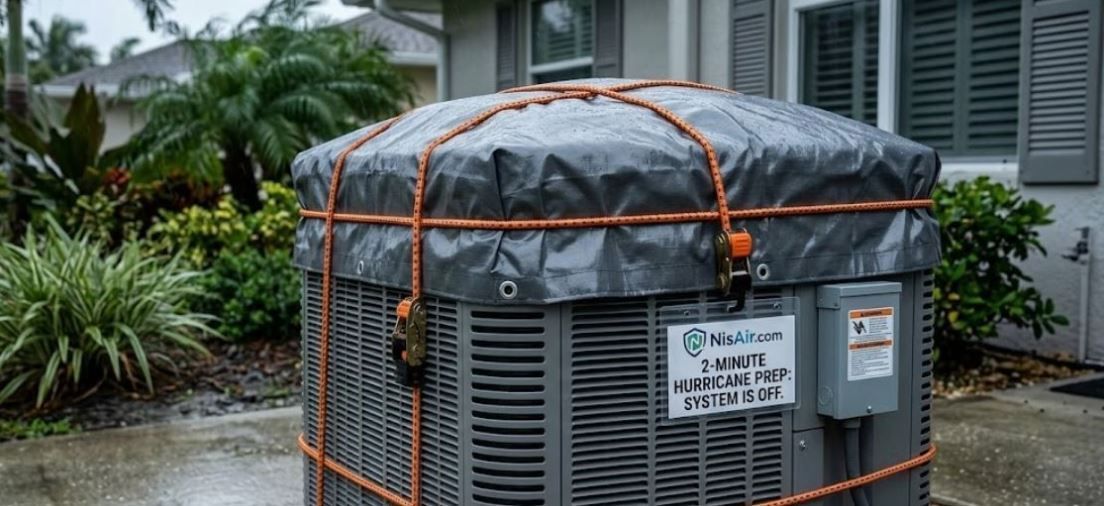
5. Cover the Unit (The Most Disputed Step): There is significant debate on this.
NisAir recommends covering your unit if you use the correct, secure method.
- WHY COVER: It protects the delicate top fan grate from flying debris (shingles, small limbs). It also prevents wind-driven rain from being forced directly into the side of the unit.
- HOW TO DO IT RIGHT: Use a specific
HVAC unit cover or a
heavy-duty tarp. The key is security. A loose tarp will act like a sail, ripping the unit off its pad or flying away and becoming a danger itself. Wrap the tarp or cover snugly around the unit and use multiple heavy-duty
bungee cords to ratchet it tightly into place.
CRITICAL WARNING:
NEVER, EVER RUN YOUR AC UNIT WHEN IT IS COVERED. This traps heat, and your compressor will burn out in 15 minutes. This is why the
"OFF at the Breaker" step (Step 3) is so non-negotiable. If you cover the unit, you must have no way to accidentally turn it on.
Wait! The Most Important Part is What You Do After the Storm
The hurricane is over. The sky is clear, and the power has been restored. Your house is a miserable, humid 85 degrees. The first thing you want to do is flip that breaker and run inside to turn the AC to "MAX."
DO NOT DO THIS.
Hurrying to turn your AC back on can destroy the work you just did.
Post-Storm Protocol: The "5-Minute Power Check"
1. Visually Inspect the Outdoor Unit: Walk outside. Is the unit still upright on its pad? If it has shifted, it could have cracked the refrigerant line (a "silent killer"). Is it covered in mud, flooded, or crushed by a limb?
- If you see visible damage, flooding, or shifting, DO NOT TURN IT ON. Call a professional HVAC technician (like NisAir) immediately. Running a damaged system is often the difference between a minor repair and a total replacement.
2. Check for Flood Levels: Look for high-water marks. If you can see that the water level rose to the electrical compartment (usually the lower 1/3 of the unit), do not turn it on. It must be professionally inspected and dried.
3. Remove the Cover: Before you do anything else, remove the tarp or HVAC cover and all the bungee cords you secured. Inspect the top fan for any debris that might have slipped through and is blocking the blades.
4. Power On (The Right Way): If the unit looks completely fine, go back to your main electrical panel and flip the AC breaker to
"ON."
5. WAIT: The 5-Minute Safety Timer: Go to your thermostat. Do NOT turn the AC mode on yet. Wait for five full minutes. Many modern compressors have built-in safety delay timers, but your system's components (like capacitors) also need a few minutes to re-stabilize after a total power cutoff. Give it 5 minutes to be safe.
6. Turn to "COOL": Only after you've waited, switch the thermostat mode to "COOL." Now you can lower the temperature. Stay by the thermostat for a moment to ensure you hear the system kick on normally. Then, walk outside to verify the outdoor fan is spinning and the system is running.
A hurricane is an expensive, stressful event, but a total
HVAC system replacement doesn't have to be part of that expense. That outdoor unit is one of the single most expensive investments in your entire house, and its survival rests entirely on that two-minute pre-storm ritual. Be proactive, protect your investment, and stay cool when the power comes back on.